
Time Traveling in Barna: Day 11, Barcelona
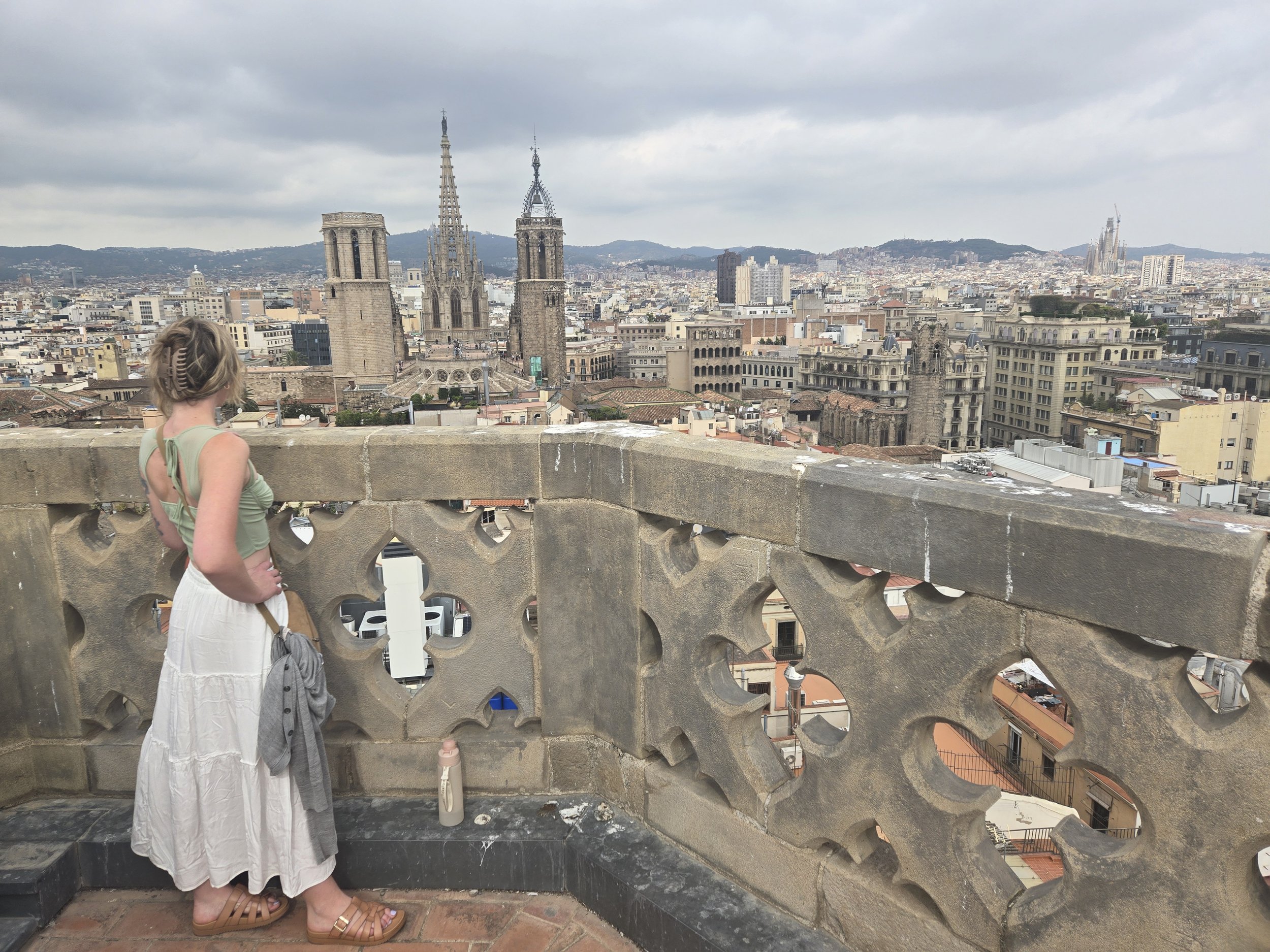
My first full day in Barcelona, nicknamed Barna, included an impromptu private walking tour, a very sad salad, tried-and-true gelato, and the act of honoring my body when it tells me I need to rest. Overall, today was spent learning about the history, myths, and legends of Barcelona, analyzing juxtapositions, and reflecting on shared human experiences.
My alarm was set for 8:30 am in preparation for my walking tour at 10 am. Already in a hurry, I said hello to my new friends at the Dream Cafe and grabbed a to-go breakfast (another carne quesadilla) before searching for the metro. Today, I had no choice but to figure out public transportation. Luckily, I had more energy and willpower than the previous day (otherwise known as commitment motivation). Anxiety is to be expected when trying to tackle something new, especially something as stressful as public transportation in a new and foreign city when you’re on a time crunch, and everywhere is a little different, but with more and more experience, you realize that it’s all mostly the same and gets a little less stressful every time.
After successfully navigating the metro to the Sant Pere district, I sat under a giant statue of a face and munched on my quesadilla, now smooshed from my bag, before meeting my tour group nearby.The closed-eyed statue of a teenage girl, I would learn later, is named “Carmela”. When viewed from different perspectives, it looks either flat or 3D and is meant to embody a theme of contemplation — the quiet, humble reflection of our inner world as individuals. It’s a universal theme that transcends all of humanity, connecting humans of all faiths and spiritualities, and that contrasts the individual and collective mind. It’s one I think many of us wrestle with on a daily basis (at least I do), balancing the inner struggles we face alone while also remembering to turn our attention outward in service of others.
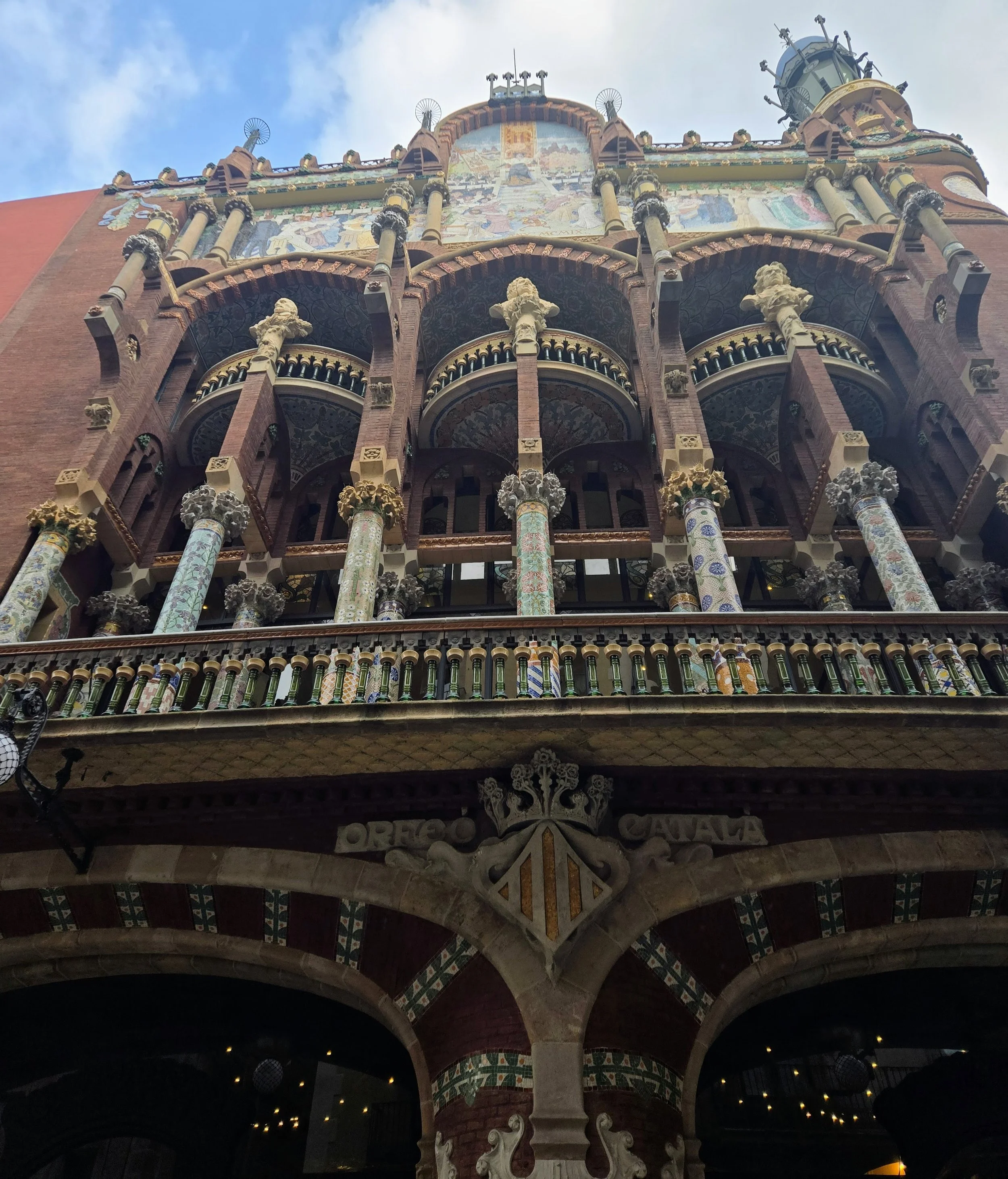
The small group tour would start in front of Palau de Musica, a UNESCO World Heritage site, where I saw my first glimpse of modern Catalan architecture (the pretty, colorful mosaic imagery you probably recognize Barcelona for). Several people were hovering around the theater, but none of my group, so I admired the intricate architecture while I waited for any signs of my crew. Finally, I was approached by a man who introduced himself as my guide and informed me I was the only one who booked the tour for this morning, so it would just be the two of us — a private tour I was both apprehensive of and grateful for. He was somewhat of an awkward fellow — new at his job and a bit hard to understand — but the light in his eyes and nervous excitement as he pulled out his thick binder of supplemental visuals immediately cemented in me a trusting, soft spot for him. He explained to me more about the concert hall, designed in the early 1900s by Lluis Domenech I Montaner — the overlooked artist and mentor of the infamous Antoni Gaudí. He described the elements that capture modern Catalan architecture: nature-inspired motifs, detailed mosaics, and iron structures. The exterior of the building is a display of captivating pink, blue, white, and green floral mosaics and bust statues, including the heads of Bach and Mozart. A brief walk through the inside displayed even more detailed floor-to-ceiling designs with green and yellow floral stained glass. The concert hall itself showcased an intricate sun and sky-stained glass ceiling surrounded by ceramic windows. My only regret was not coming back to see a show in all its glory.
The tour continued down the alleys of the Old City (Ciutat Vella) with ceramic tiles that signaled one-way streets for previously used horse-drawn traffic. I was guided to hidden gems that included local patio cafes and historical art centers, including Cercle Artistic de Sant Lluc. This space, founded in 1893, has been a center for artist societies that have included intellectuals and art lovers such as Gaudí, himself, and the controversial yet infamous Pablo Picasso. The center served as a meeting point for exhibitions and discussions, and was the starting point for art movements and initiatives. Simply occupying the same space where all of these historical figures once created gave me surreal, ghostly vibes.
As we crossed over Via Laietana, a road that separates the Old City into the Gothic Quarter and El Born districts, I asked my guide about the red and gold striped flags I saw hanging from several residences. I was intrigued to discover it was the Catalan flag, representing pride for the region and aspirations for an independent Catalonia. For me, it was a reminder that freedom and independence are a universal desire — to live and move about the world freely and to express and identify ourselves in a way that rings true for us. Whether as a people or an individual, we are all called to walk different paths and desire the freedom to do so.
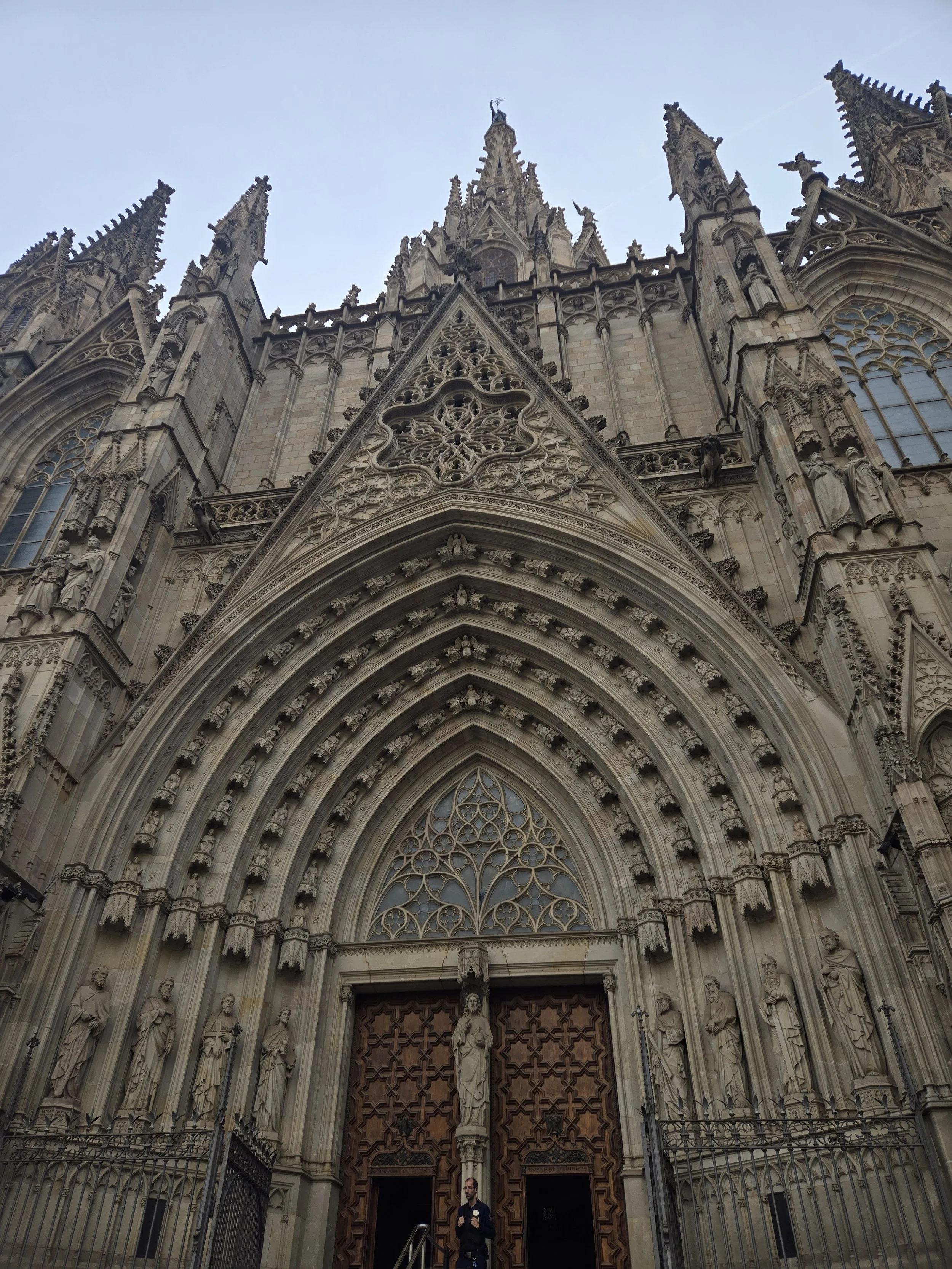
On the other side of Via Laietana in the Gothic Quarter stood the Cathedral of Barcelona, a medieval, Gothic contrast to the bold and colorful, contemporary Catalan architecture. To say it is a historic site is an understatement, as the 13-20th century cathedral was built on top of a sacred 2,000-year-old Roman church whose walls and underground column remains can still be witnessed (however, do not be fooled by the street view replicas). The cathedral that stands today is dedicated to the young Saint Eulalia. Believed to be buried beneath its crypt, Eulalia is a Christian martyr legend who was tortured for her faith in the early 4th century. Along with the cathedral, her cultural influence is seen in alters and memorials around the city, reflecting a theme of courage and conviction — or perhaps, it’s an emotionally manipulative power play to fuel the Christian religion in an attempt to control the masses. The jury is still open, but I choose to see the beauty and inspiration in it.
Across the cathedral stood the Architects’ Association of Catalonia building, exhibiting the politically rebellious sketches of Pablo Picasso created during a time of political suppression in the Franco dictatorship era. The sketches depict Catalyn culture and identity, including sketches of children, giants, and the Catalyn flag. Giant culture, I learned, originated from biblical storytelling in the 14th century and has since been a staple in Catalan (and Spanish) culture, now seen representing not only biblical figures, but historical heroes and fantastical beasts, as well. Throughout my time in Spain, the presence of giants and their cultural impact will become increasingly evident.
Our next stop was a stroll through the courtyard of Casa de l’Adiaca, the former residence of the cathedral’s Archdeacon, as well as a legal hub. What’s interesting about it is its building blocks, with parts of it built using the old Roman wall, incorporated later with Gothic and Renaissance elements. Also inspiring is its marble mailbox, designed with a swallow and tortoise to symbolize swift justice hindered by bureaucracy. More importantly, though, it is believed that touching the tortoise will bring you good luck, and if you touch the swallow, you are destined to return to Barcelona. Needless to say, I didn’t hesitate to pet the wall.
As we weaved through the winding streets of the Gothic Quarter, I was mesmerized by the handsome street guitarists and the sampling of Catalán chocolate. As we travelled through time, stepping foot into each “Quarter century”, and as I listened to my guide tell stories and fun facts about the city, the history and expansion of Barcelona came alive. My favorite legend I learned as we strolled Barcelona’s squares is a borderline fairytale. Legend has it that a town terrorized by a dragon that had taken its princess captive was saved by a hero they call Saint Jordi, who had slain the beast. Out of the dragon’s blood grew a rose bush, from which the valiant knight plucked a rose to gift the rescued princess. Today, Catalans celebrate this love and bravery every year on April 23rd as roses are exchanged and decorate the streets. Personally, I think it’s the most romantic thing I’ve ever heard.
My private tour came to a close as we ascended the centuries-old and claustrophobic, winding staircase up the bell tower of Basílica dels Sants Màrtirs Just i Pastor. The church was old and quiet and seemed to be tucked away and invisible to the rest of the world. As we climbed, I was taken back in time as we spiraled up the cold and musty staircase full of bird crap. I was also getting rather dizzy. Finally, the light from the top stair came to view, and I could breathe again — sort of. A little winded and sweaty, I was now staring at the birds-eye view of Barcelona from sea to mountain. Here, I was transmuted back into the 21st century as the canopy of concrete rooftops and satellite dishes surrounded me. The enchanting history of Catalonia and its detailed, romantic architecture were now hidden. The only reminders that such history existed were the church bell towers sticking up, sorely out of place, through the canopy.
After my tour, I tried to backtrack my way through the Ciutat Vella. I wanted to linger in the places I had just visited and spend more quality time admiring the sights and taking photographs. It was a lot more difficult than I thought it would be, and I was quickly losing energy. To refuel, I settled on a restaurant near a church and ordered a refreshing-looking summer salad that turned out to be more of a side dish than a main course. Embracing the oath I took in Madrid to slow down, I did my best to take my time inhaling my tiny lunch, then sipped on my water and people-watched out the window until I grew restless and found some gelato to fill the void in my stomach.
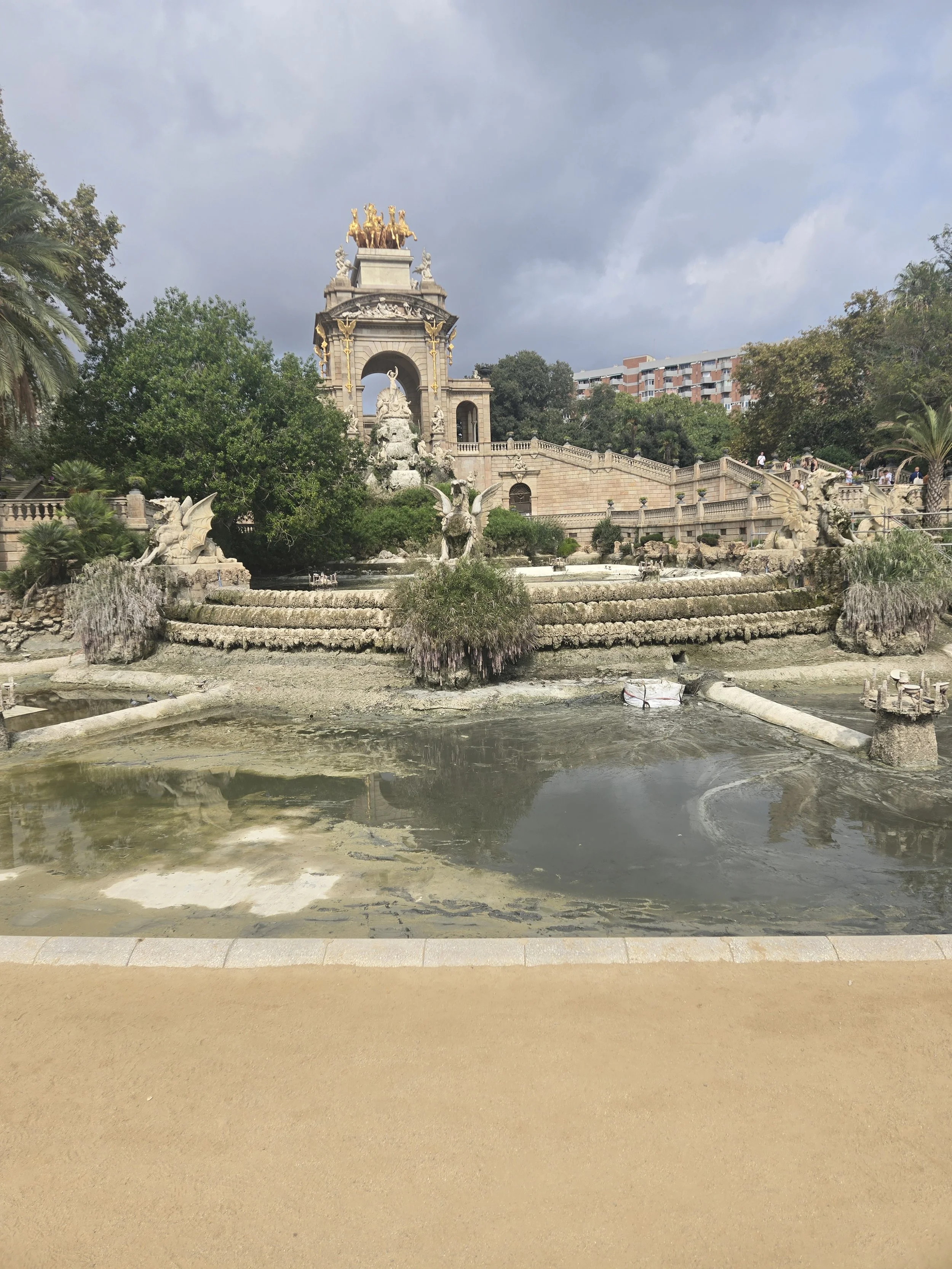
Even after attempting to refuel, I noticed I was slowing down, and not in a stop-to-smell-the-roses kind of way, so I planned to hike to the large park on the other side of the city, Parc de la Ciutadella, in hopes of resting and recreating the inner peace I discovered in Madrid’s Retiro Park. One of my toxic traits is trying to recreate fond experiences, so it shouldn’t have come as a surprise that this experience was much different. Although it had a large pond full of swans and The Notebook-worthy love canoes, the park was not as secluded as Retiro, so the peace and quiet I longed for was substituted for irritation and a close proximity to other people. I did my best to ignore the red feelings bubbling beneath my surface, to distance myself from others and focus on the beauty around me, including the massive, waterless fountain under construction. If I hadn’t been so irritable, I probably would have told you all about the long dusty walking paths lined with palm trees, the pink Arabian domed palace that sat in the middle, the grand Cinderella staircase with gold features that bordered Barcelona’s “Trevi Fountain”, and the lively guitar music that filled the air. Nevertheless, I was never going to appreciate any of it if all I could think about was the traffic noise and getting frustrated with not being able to find a quiet and secluded place to be by myself away from others. Finally, I honored the warning signs and listened to my body telling me to go home and rest. I had a wonderful morning and learned a lot on my tour of the city, but I had to accept that I just wasn’t feeling it anymore. I fought the guilty thoughts as I entered my empty room back at my hostel and climbed into my bunk at 3:30 pm, but as I closed my curtain behind me and shut myself off from the rest of the world, alone and quiet at last, I felt my body relax, and my mind start to soothe itself as I rested and opened up my book until the sun went down.
Travel tips:
Be vigilant, but fearless. If you find yourself on an impromptu private walking tour with a man, certainly be hesitant, but if the vibes are right, embrace the opportunity for the upgrade!
Prioritize fuel! I get the feeling that if I hadn’t waited so long to eat and if I had taken the time to have a real meal, my mood would have been much more elevated, and I might have had more energy to explore.
Nonetheless, if your body is telling you to take it easy and rest, it’ll be much less painful if you just do what it says. There is no shame in resting on vacation! Or resting in general, for that matter.
