
A Perfect Day in Barcelona (Just Not For the Reasons I Expected)
Do you ever go into something with high expectations only to leave underwhelmed and a little disappointed? That was not the case today. Not that I had high expectations going into today’s attractions, but the expectations I did have were unexpectedly exceeded. Keep reading to hear about the (almost) perfect day in Barcelona, including attractions you don’t want to miss.
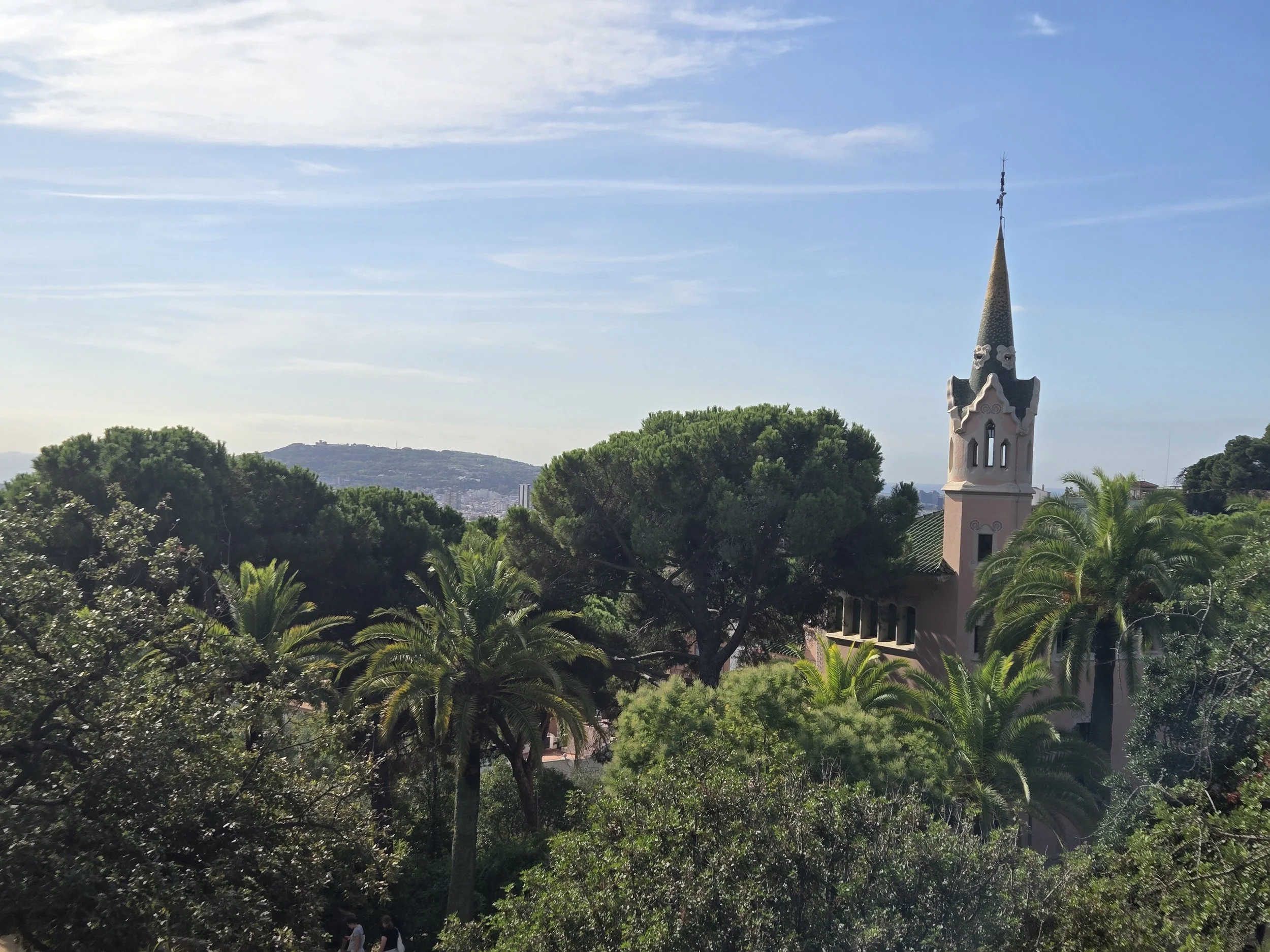
Morning-Afternoon Tour of Park Güell
I didn’t have too much time to dally this morning as I hopped on a train to Park Güell at 11 am for a guided tour of the park — you know, the one with the famous balcony pics. In hindsight, I probably should have taken a taxi to the entrance, as the train I took stopped on the opposite side of the park where I was meeting my group. Not only did I have to climb San-Francisco-steep roads to get to the edge of the park itself, but I ended up hiking an extra 30 minutes up and around a mini mountain — a hike I hadn’t anticipated, or I would have had a bigger breakfast. By the time I reached the meeting point, I was sweaty, thirsty, out of breath, irritated, slightly faint, and a little late. It took an annoying amount of time to find my guide in the sea of 20 other tour groups. When I did, I was not only relieved to relax, recover, and let my guard down a little, but to discover I was not the last of my party to arrive. My irritation faded as I sparked up a conversation with an American couple from Michigan, a retired high school art teacher and professional photographer (I am clearly on the right frequency). It’s amazing what a little human connection can fix. By the time we were all situated and ready to begin, I was back to normal, happy, hydrated, and only slightly faint (thanks to the granola bar I had the foresight to pack).
I was grateful for the earbuds and radio provided by my guide (one of many I will come to collect in the next three months), which acted not only as a speaker for my guide’s fun facts, but his direction and location as well — a necessary accessory in the herd of crowds, including my 15 or so group mates. It also allowed me to wander off a bit — as far as its bandwidth would carry me, that is. I enjoyed the flexibility and freedom to deviate from the group and reflect in solitude at times without missing anything. Although I’m sure it stresses out the guide to herd a bunch of wandering tourists.
Thankfully, the crowds died out as we drew farther from the entrance and deeper into the park; I was grateful to hear the wind in the trees and the songs of birds again as we basked in Gaudí’s incredible mountain. I was surprised (and in awe) to discover that it used to be dry until Guadi imagined a Garden of Eden across its foothills. The entire mountain acts as a giant, self-sustaining water system, and now, the hills are filled with lush greenery and nature-inspired bridges and balconies.
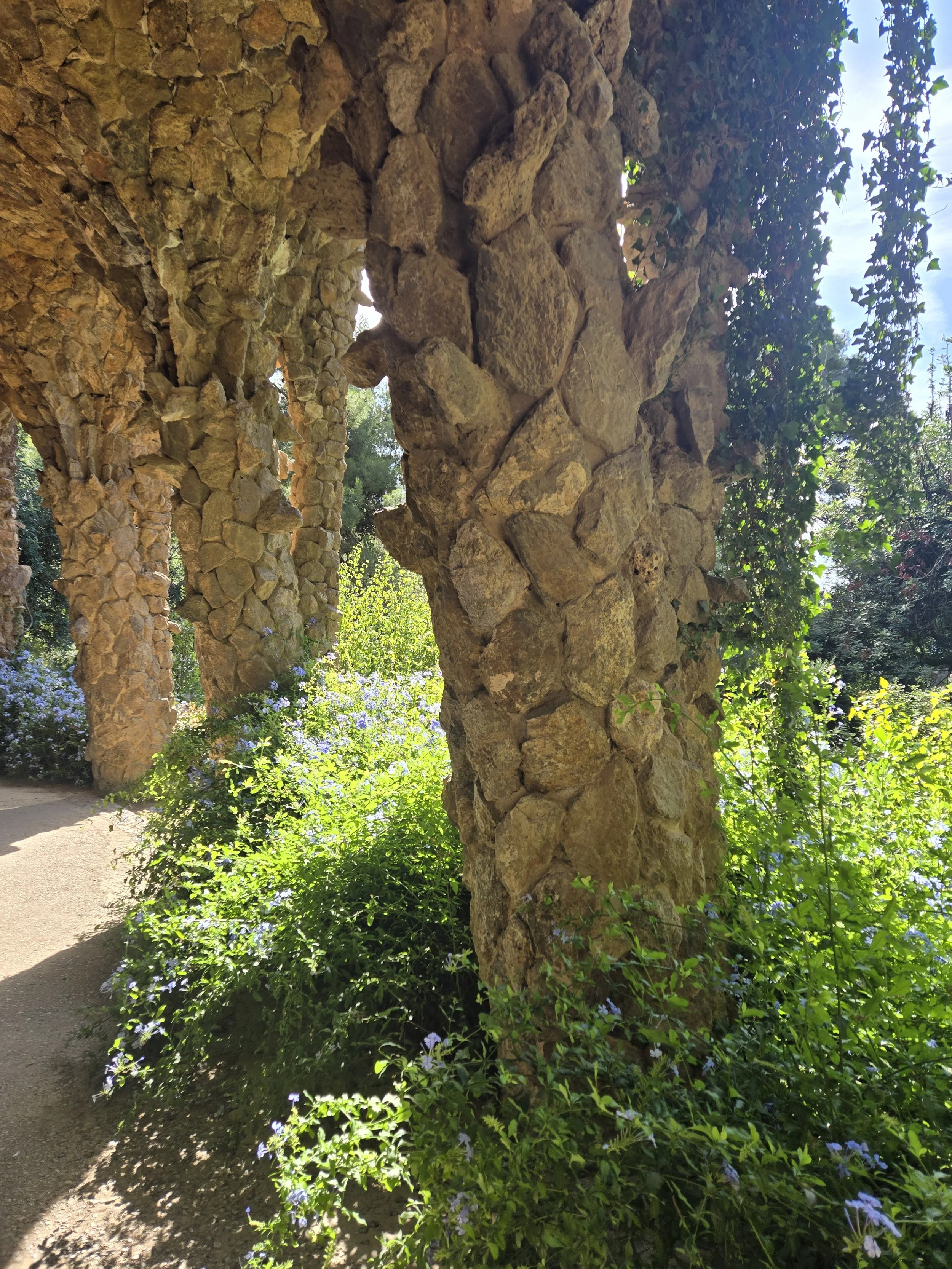
Our first stop was exploring Els Tres Viaductes (The Three Viaducts) — three cave-like bridges designed for horse-drawn carriages on top and strolling pedestrians below. The structures mirror the natural environment around it, reflecting cave stalactites, tree canopies, and even bird nests. Its acoustics are also an attraction for many musicians, and I couldn’t help but dream of romance and linger in the bandwith of the handsome guitarist nearby, ignoring all the fun facts from my guide at the time.
As we walked through the Jardins D’Austria (Austria Gardens), views of the few historic buildings flanked the horizon. To the south, the Gatehouse Pavilions, also known as the “Fairytale Houses,” resembling gingerbread houses with rooftop icing, guard the main entrance. It was formally home to the park’s caretaker and family, but is now home to the Barcelona History Museum. To my surprise, the park was originally designed to be a gated residential community, though only two homes were ever built. Only one is still a private residence — Casa Trias — home to Gaudí’s lawyer, which remains in the family. To the north sits the Gaudí House Museum, which was once a show home to attract buyers and was also home to Gaudí’s father for a time. The museum now showcases original furniture and personal items that belonged to Gaudí. Lastly, what was once the manor of Casa Larrard now hosts the Baldiri Reixac School. As I explored its surroundings, the music of children playing in the schoolyard sent waves of hopeful and uplifting energy throughout the park (I turn into a bit of a cheeseball around kids).
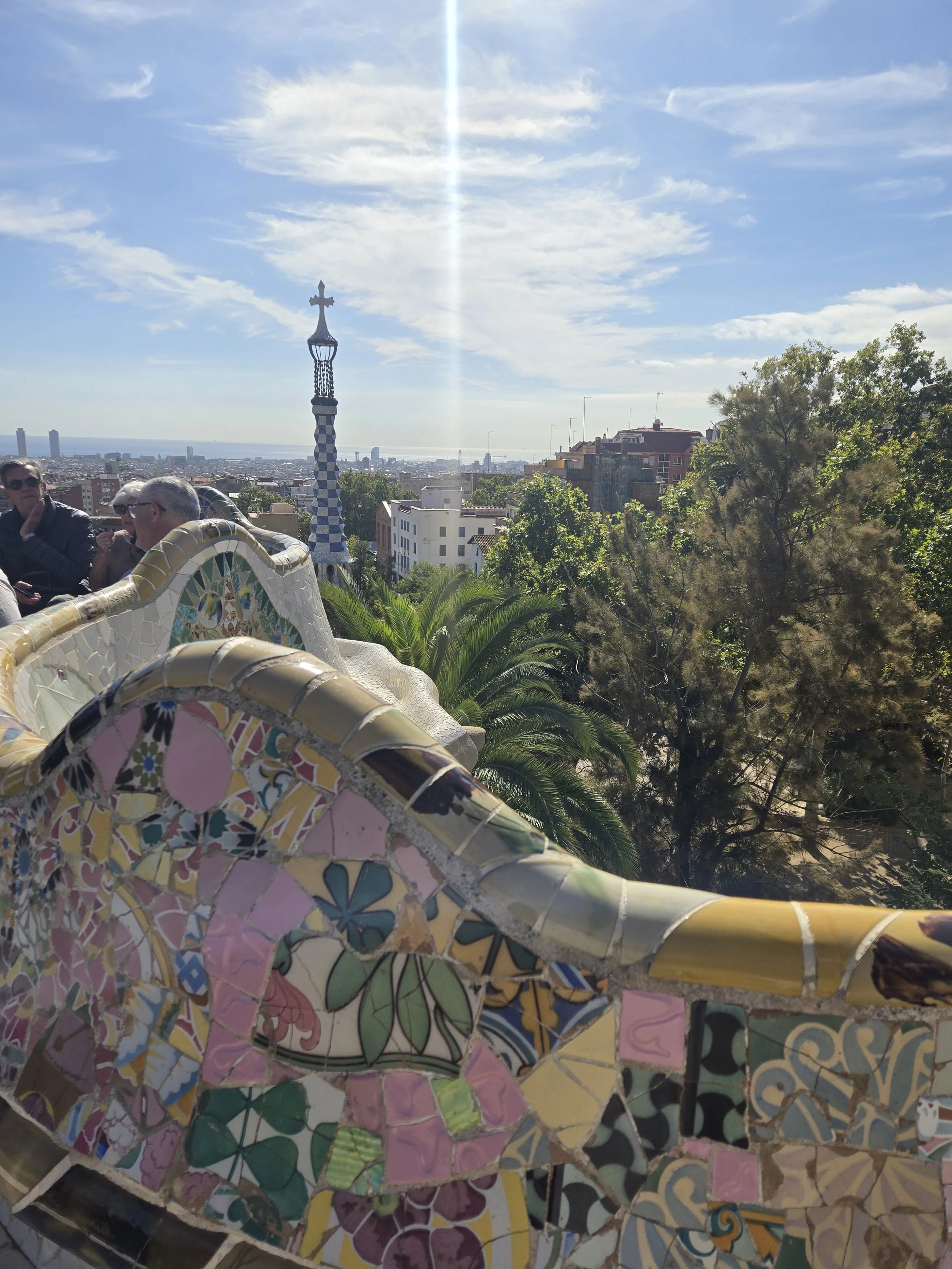
The tour ended below the famous Barcelona balcony (Placa de la Natura or “Plaza of Nature”) in what is called Sala Hipostila, or “Hypostyle Hall”. It is a grand, columned (86 columns to be exact) space originally designed to be a marketplace for the failed neighborhood. Its ceilings are covered in — you guessed it — a mirage of mosaics. Circular medallions representing the four seasons are stationed among the domed ceiling — rather fitting, I’d say, for the hall’s intention. The crowds were much thicker here, as it was the park’s landing point, or destination, for the tourists. Once we hit the commotion, everyone was antsy to disperse, including me, and the guide worked extra hard to hold our attention a little longer before collecting our audio devices and bidding us a farewell.
On my own again, I took my guide’s advice to seek out the Hill of Three Crosses, but didn’t get far, on account of I couldn’t find it, and also, the energy of my granola bar was wearing off. But, there were parts of the park I still wanted to explore, so I abandoned the quest to take my chances exploring the busy “picture-worthy” balcony. As far as I could tell, the view was a little underwhelming. It was the balcony itself that I was mesmerized by, but I am a sucker for mosaics. The detail, intention, and abstract natural designs, along with the range of bright colors — pinks, greens, blues, yellows, and oranges — were, in my opinion, the subject of this beautiful view. I could have studied them for hours, and would have, if it weren’t so busy. I was able to capture a few nice pictures, however, before hightailing it out of the crowds in search of peace and serenity in the park’s quiet, lush gardens.
As I wandered the trails, soaking in the scene — just about ready to call it quits and find lunch — I was summoned by the sound of music coming from atop the hill (and a rather large climb). Their soulful chants, beating drums, and guitar strings called to me like a siren, and I ignored all bodily signs of hunger to follow it — a quest I did not regret. I climbed the last few stairs into a clearing and found two musicians singing and playing to a surprisingly small crowd. I found a seat on the stone frame around the intimate circle and let the music fill the spaces inside me. Have you ever been so present that you’re transported somewhere else entirely?
Eventually, my stomach grounded me back to Earth, and I was forced to peel myself away in search of food (but not before being pulled into another group of musicians along the way). I descended the green hills, past the balcony and Hypostyle Hall, down the dragon staircase, and through the park gates that read “No Re-entry”.
“Menu de Dia” Lunch at Store Cafe
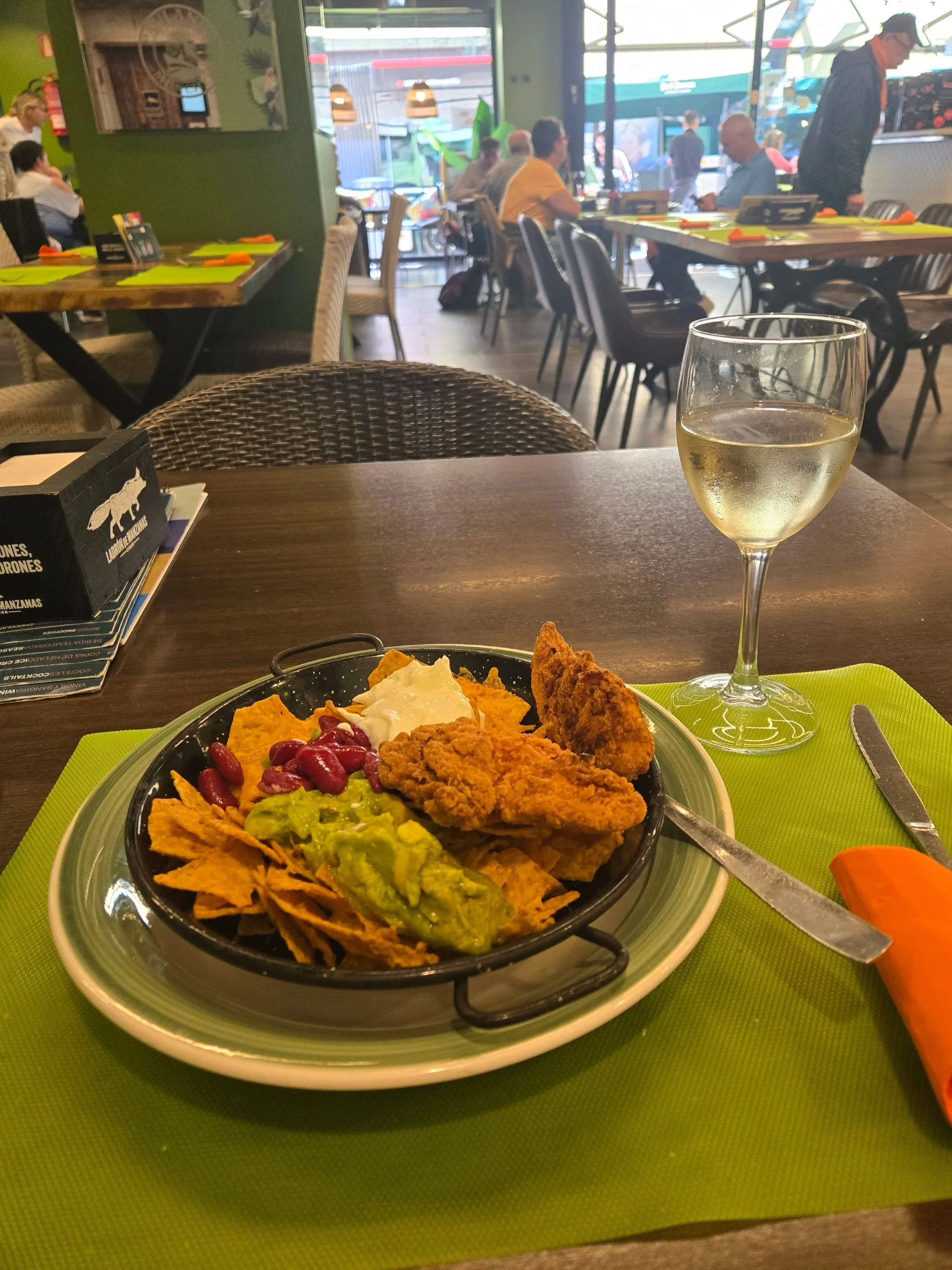
It took me a while to decide on a place to eat. I probably passed by a dozen eateries (although I stopped at just about every souvenir shop in search of my Barcelona magnet). I had hoped to perch myself on a patio table along one of the quiet side streets, but I eventually settled on a place along the main drag at a place called Store Cafe. Thankfully, the noise of traffic and pedestrians disappeared as I stepped inside the quiet cafe. I seated myself on the booth side of a table at the back of the restaurant, where I could observe the space from a distance and seclude myself as I took out my iPad to read. I ordered from the Menu de Dia (menu of the day), starting off with a delicious veggie broth soup and refreshing white wine, moving on to a very tex-mex entree that included chicken strips on top of a bean guacamole nacho plate, and finished with the best cup of coffee I ever had — so much so, that I raved about it to my server in the bathroom.
Afternoon Visit to Casa Vicens
I was riding high after my lunch, as I always do after a delicious meal and a satisfied belly, and had some time to kill before my basilica tour. Not having had my fill of Antoni Gaudí yet, I decided to take the opportunity to visit another one of his residential creations and architectural masterpieces, Casa Vicens, and I am so glad I did. It was a toss-up between visiting Casa Batlló and Casa Vicens the day before. Ultimately, I decided on the most popular one (Casa Batlló), and if I hadn’t had the opportunity to go today, I would have never known how underrated this house truly is. In my unpopular opinion, Casa Vicens is my favorite of the two, and if I had to pick one, that’s what I would choose. Perhaps this is because I toured Casa Batlló at night, so I do say that with a grain of salt, but as of now, that is my experienced opinion.
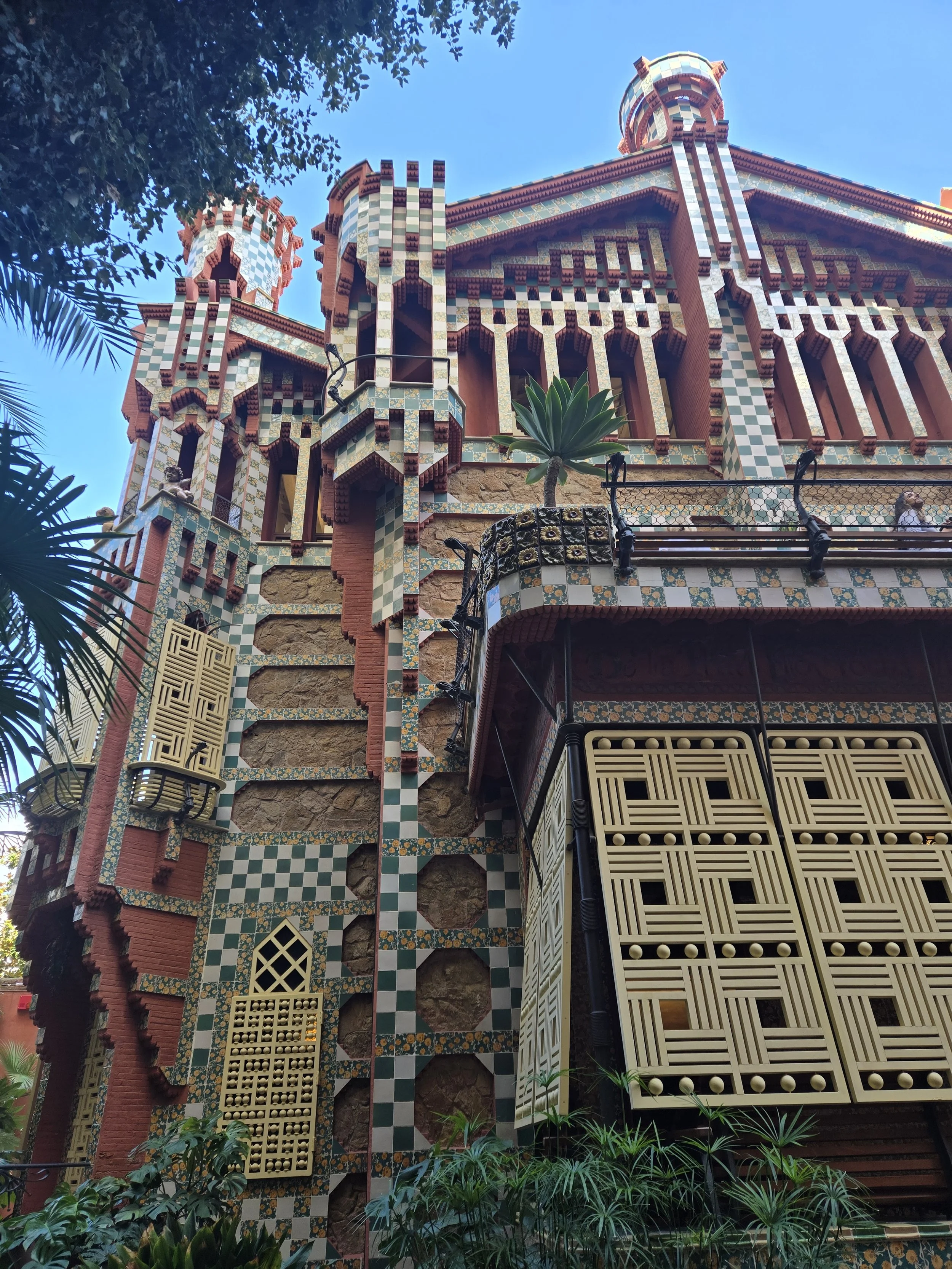
Casa Vicens was Gaudí’s first major commission — a summer home for a wealthy stockbroker in what was, at the time, a rural agricultural village. The house is now tucked away between modern city buildings; What I would give to see it in its country glory. There is no inch left untouched by character. On the outside, orange floral and green-and-white checkered tiles share space alongside earthy yellow geometric shutters on a red-orange brick and large stone foundation. The inside shared similar features and more, including a Moroccan-style chandelier, stained-glass windows, and a blue-gold muqarnas ceiling that transports you into a different dimension. Gaudí was heavily influenced by Islamic and Moorish style designs, which this house showcases. Blending this with nature-inspired elements is what I love most about his work. As if his designs weren’t inspiration enough, at the end of the house tour was a mini museum and this quote by Antoni Gaudí: “Imagine a house, neither big nor small, one which we could call ordinary, by enriching and enhancing it, it will become a palace.” To me, it’s a reminder not only to romanticize my life but to fill it with love, beauty, and connection (to nature and to others) — to create a beautiful life with intention and harmony, to enrich the ordinary, and to see the beauty in all things.
Sunset tour of La Sagrada Familia
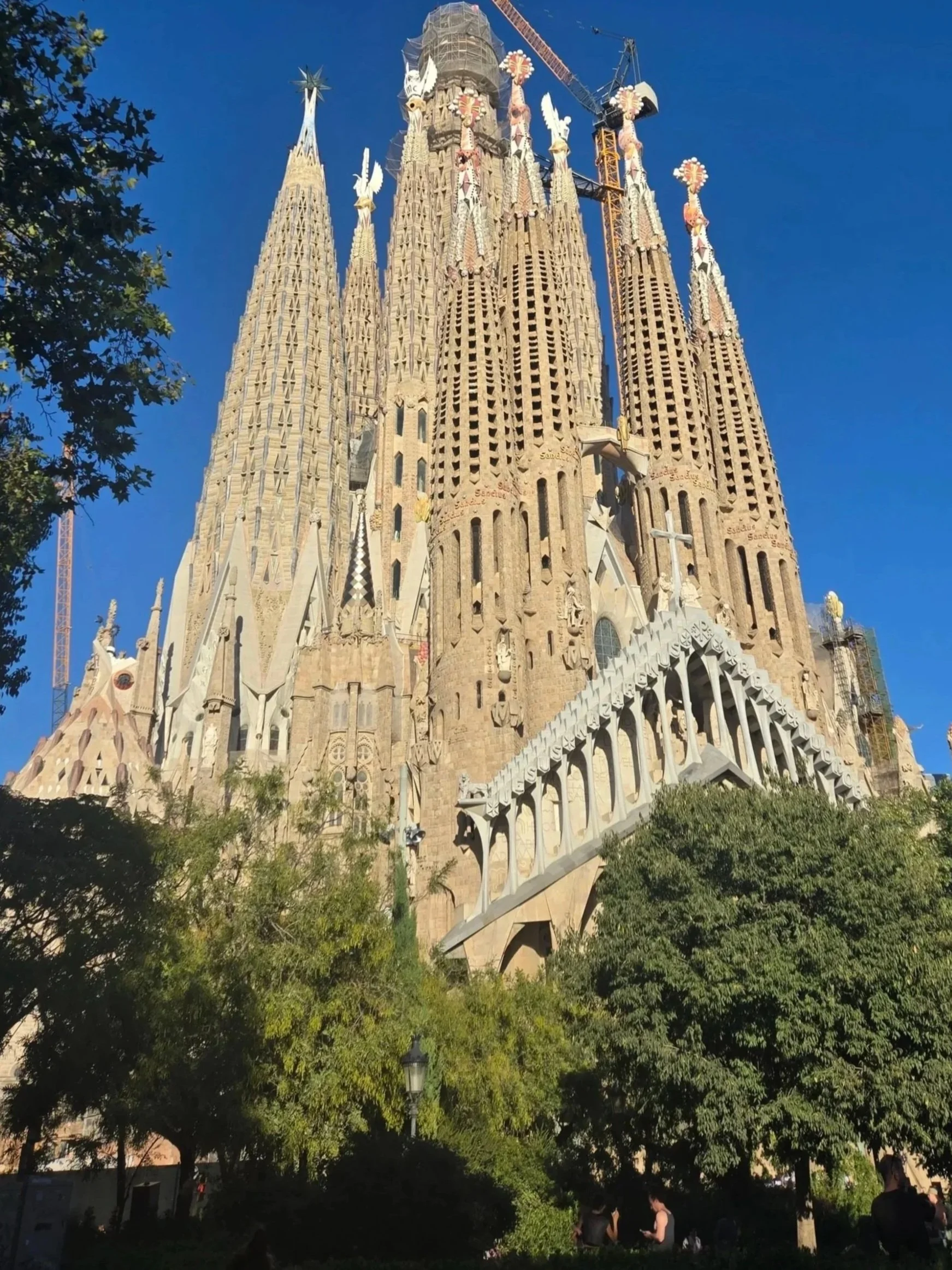
After my visit with the country house, it was time to make my way to the Basilica de La Sagrada Familia — the Eiffel Tower, Northern Star, and city treasure of Barcelona. You often wonder if an attraction is going to live up to its hype, so I didn’t get my hopes up, but when I stood in front of this massive church, craning my neck to see the top, I was reminded of my trip to the Grand Canyon with my brother. We almost passed on it to save time, thinking it probably wasn’t worth the hype anyway, but decided to go at the last minute. We were mid-conversation when we saw the first views of the canyon — not only did the convo come to a dead halt, but our jaws dropped, and we were speechless aside from an “Oh my God!” and “Holy Bleep!”. That is how I approached the La Sagrada Familia.
I had some time before my tour started, so after gawking at the church, I walked the nearby park grounds to find a bench to read on, glancing back (and straining my neck) at the basilica now and then. I was lucky enough to find one and was just getting settled when, out of the corner of my eye, I saw a strange man approach a little too close for comfort. I couldn’t tell if he was simply disoriented — distracted from the views like myself — out of his mind of some sort, or in a ploy to take advantage of me. Either way, I grabbed my purse and belongings, holding them close to my chest and shot him a “what the heck are you doing” death stare, which either sobered him up, like “oh shit, my bad” or scared him off in a “don’t fuck with her” kind of way. I glanced at the lady with the poodle on the bench across from me for a reaction and got none, so I carried on with my day, albeit slightly more guarded than before. Thankfully, I didn’t have to linger long.
Soon, I made my way to the meeting point where I found a few others waiting. At the same time, we all approached each other to inquire about the tour group, as there was no guide in sight (and the instructions were very clear about arriving on time). We were all getting a little nervous (did we get scammed?), and we approached another guide we had spotted for help. He was unhelpful, but eventually he started calling out names, mine being one of them. A wave of relief struck me as I realized he was my guide, but when he finished roll call without calling on the others, I felt equally as bad for them. As my group started heading off towards the basilica, I lingered to provide emotional support and good-luck wishes to those left behind.
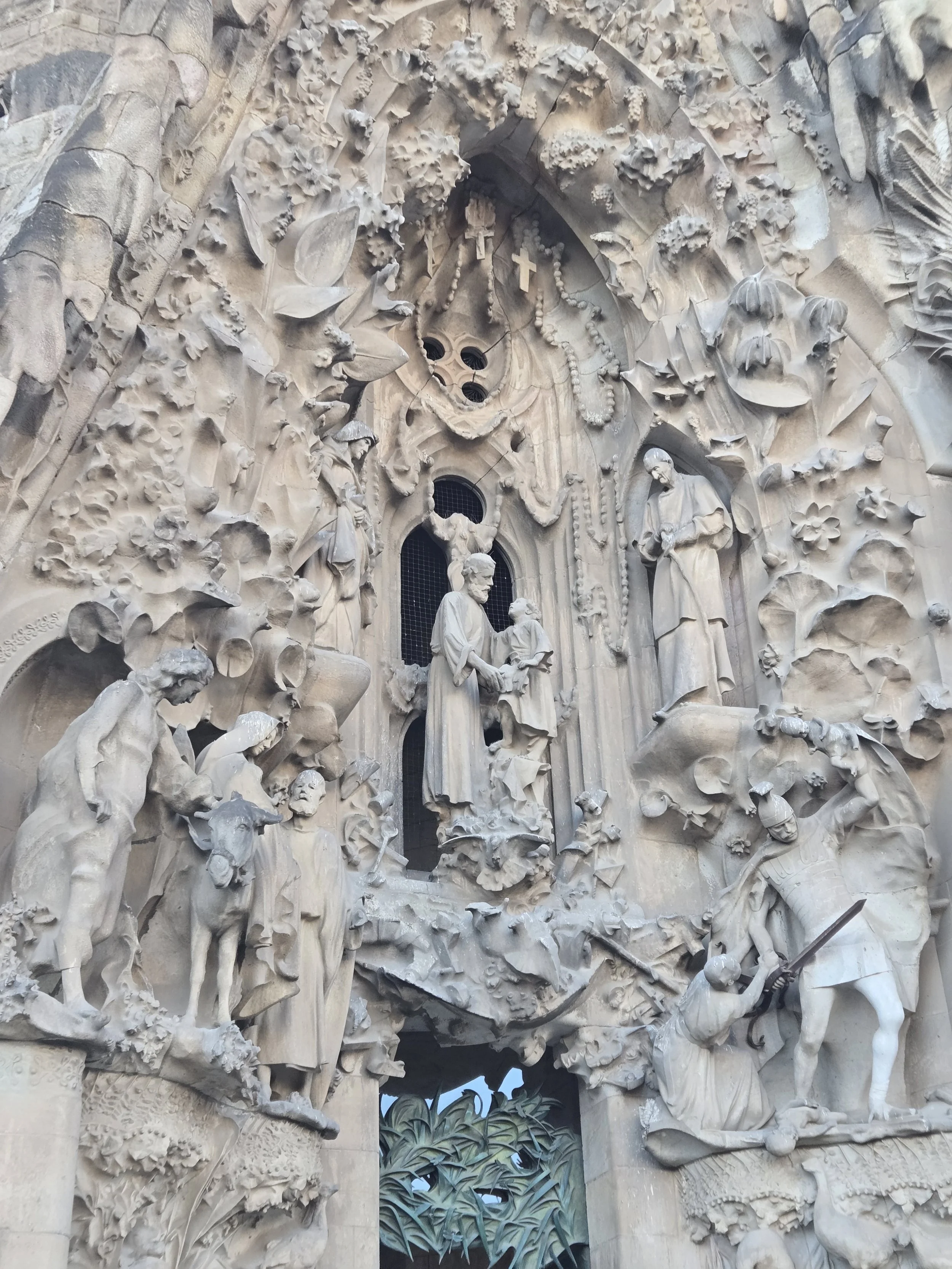
When I was looking into tickets for La Sagrada Familia, there were only group options available at the time, which wasn’t my first choice, to be honest. As I mentioned before, I prefer the flexibility of flying solo. But when we passed the absolutely, terrifyingly, massively long line for single-ticket users (including same-day entry, I would assume), I was thanking the heavens for my skip-the-line group-ticket access. A quick security check and another pair of headphones with an audio guide later, and we were in the grounds, up close and personal with Jesus. We spent quite a bit of time on the outside, admiring the detailed carvings of scripture stories as our guide described what we were looking at. And to be honest, I probably wouldn’t know what I was looking at if it weren’t for him — another reason to be grateful for the tour.
Construction of the basilica began in 1882 as a traditional Neo-Gothic church until Gaudí took over in 1883, putting his nature-inspired spin on Christian symbolism. Construction is expected to finish in 2035, nearly 150 years later, and I felt blessed to have the opportunity to revel in it’s more completed version of history. Even after many of Gaudí’s plans were destroyed during the Spanish Civil War, rescued fragments and modern technology have reconstructed them to honor Gaudí’s original work to the best of their ability. As it stands today (after the completion of the Tower of Jesus Christ), the Basilica de la Sagrada Familia is the tallest church in the world at 566 feet. Also, as of today, it is still the most magnificent church I’ve ever seen (and I’ve seen a lot).
True to his work, the basilica represents the entirety of Christian theology and the laws of nature. To Gaudí, it was to be a “Bible written in stone” where every column, window, and spire tells a spiritual story. The 18 towers, or spires, are dedicated to biblical figures — the center and tallest being that of Jesus, of course — and the three grand entrances represent different stages in Jesus’ life.
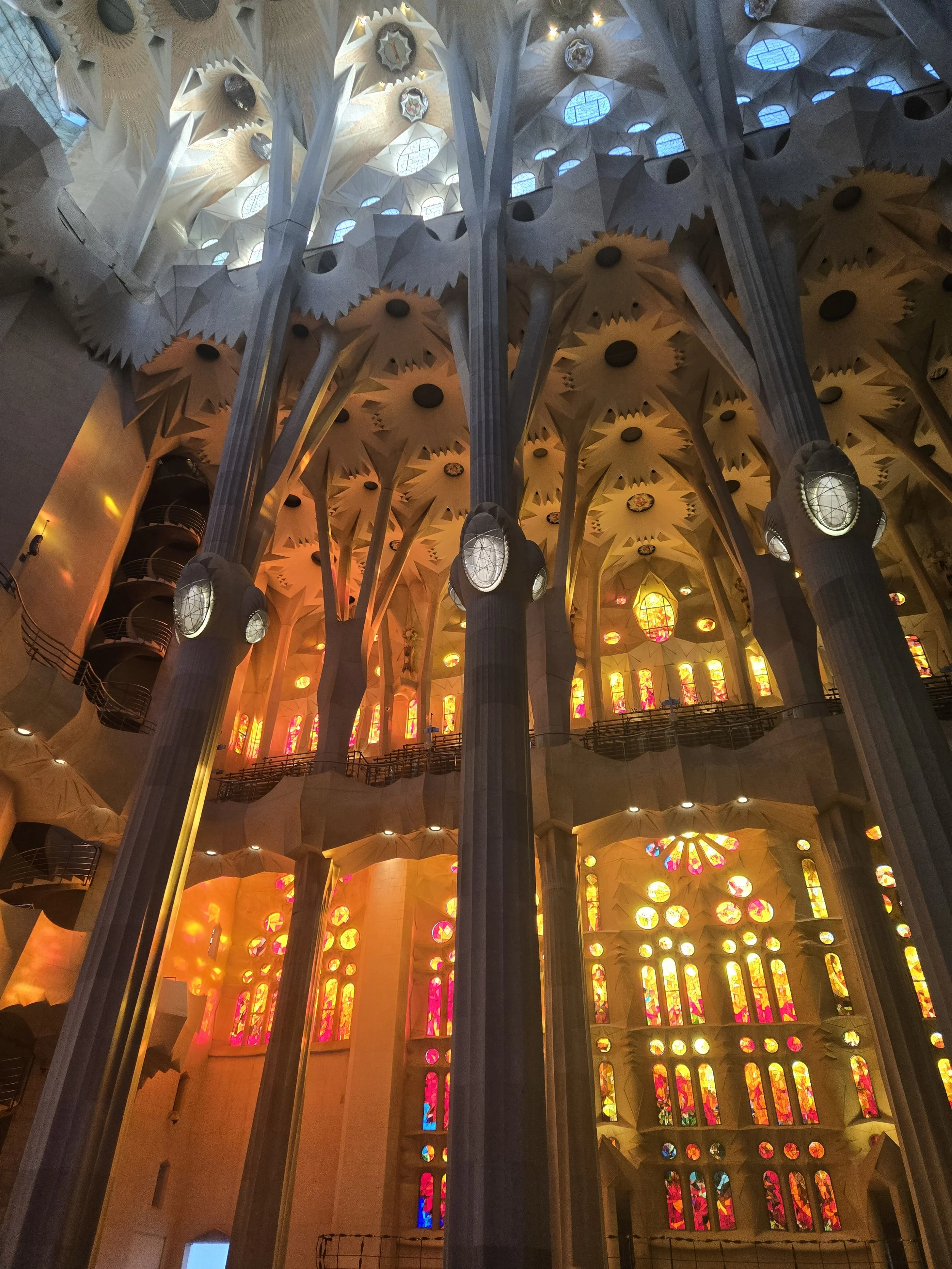
On the inside, Gaudí used organic patterns to mimic a living forest: giant columns mimic trees that branch out at the ceiling, and stained glass windows create a canopy of light — one side of the building reflecting cool blues and greens in the morning, and the other side, warm reds and oranges as the sun sets (your clue to visit either early morning or late afternoon).
No matter your faith, religion, or God, all of it came together as one unified source under this spiritual canopy. As soon as you stepped into its walls, a still and powerful presence washed over you, and you knew you were in the presence of something untouchable and larger than life. God, Spirit, Source, Love, The Force, whatever you name it — it’s energy dominated the space like a forcefield.
After the tour ended, we had an additional 30 minutes to explore the church by ourselves — another blessing. I studied (and photographed) every angle, but eventually I had to put my camera down, plant myself in a pew, and meditate on the magnitude of the building before me. Truly wishing I had more time here, but thankful I was able to see it at all, I obliged the voice over the speakers when it told us it was time to vacate.
As I stood on my train back to the hostel, I reveled in the (almost) perfect day I had here in Barcelona— mindful, intentional, beautiful, spiritual — Gaudí would be proud.
Back at the hostel, I finished my day with packing, a warm shower, and sending a picture of my international driving permit to my next Airbnb host. Tomorrow, I will be leaving Barcelona for an exciting new adventure and a sneak peek into my dream life — van life in Majorca!
Travel tips:
For guided tours, bring your own headphones (with the cord) to avoid collecting more headphones than you could possibly need. Most importantly, it’s the eco-friendly choice. I learned this way too late, having collected at least six headphones before remembering or having the forethought to bring my own.
Park Güell visiting hours: as with any tourist attraction, I recommend the park in the late afternoon/evening when the crowds die down, and there is better lighting. The early morning might do as well.
Menu de Dia: Look for these Spanish menus at your local restaurants for lunchtime specials.
Booking in advance for La Sagrada Familia: You will need to book tickets in advance! I mean, at least a week or two in advance, and I would highly recommend a guided tour. It costs a bit extra, but it is worth the history and architecture lesson, as well as the skip-the-line bonus, and once you’re in, you are free to explore on your own after your tour is complete. You get the best of both worlds!
